How to Revolutionize Hemp Micropropagation with AI and Tissue Culture?
Can AI and tissue culture unlock the future of hemp cultivation? Discover how these innovations are revolutionizing micropropagation with advanced machine learning techniques and optimized growth strategies for maximum yield and efficiency.
 by Maryna Kuzmenko | 05th August 2024 | 5 mins read

The integration of artificial intelligence (AI) with plant tissue culture is transforming the way hemp is cultivated. This cutting-edge approach is pushing the boundaries of hemp micropropagation, enabling cultivators to optimize growth and boost yields with precision.
Today we will check two groundbreaking studies: the first one will be about AI-powered tissue culture for enhanced micropropagation and the second study is about non-invasive hemp cultivar and sex determination with AI. However, firstly, let’s remind the basics.
Fundamental Facts About Hemp and AI
- Artificial intelligence optimizes various stages of hemp cultivation, from seed selection and germination to yield prediction and pest control.
- Machine learning algorithms analyze vast datasets to refine growth conditions, ensuring healthier plants and higher yields.
- Plant tissue culture combined with AI allows for rapid, disease-free propagation of hemp plants, essential for maintaining genetic consistency.
- AI helps growers make informed decisions by predicting plant health, nutrient requirements, and environmental adjustments in real-time.
- Countries like India, Iran, South Africa, Australia, and Germany are pioneering AI applications in hemp biotechnology.
AI and Tissue Culture Revolutionizing Hemp Micropropagation
On 12 July 2023 the consortium from 🇮🇳 India, 🇮🇷 Iran, 🇿🇦 South Africa published an insightful research paper.
This study explores in details the integration of Artificial Intelligence (AI) and plant tissue culture techniques to enhance the micropropagation of hemp.
Researchers employed several methodologies, including machine learning (ML) algorithms such as:
- Support Vector Classifier (SVC),
- Gaussian Process (GP),
- Extreme Gradient Boosting (XGBoost),
- Random Forest (RF), and
- Multilayer Perceptron (MLP) neural networks,
They focused on optimization in vitro germination and morphological traits of hemp seedlings. They also utilized Response Surface Methodology (RSM) to compute the optimal concentrations of hydrogen peroxide (H₂O₂) for maximum germination and seedling growth.
The study found that the Random Forest model exhibited high prediction accuracy with F1 scores ranging from 0.98 to 1.00. Optimal H₂O₂ concentration was determined to be approximately 2.2%, significantly enhancing germination rates and seedling growth.
These findings demonstrate the potential of AI in improving the precision and efficiency of hemp micropropagation.
Hemp cultivators and biotechnologists can apply these AI-driven tissue culture techniques to improve the yield and quality of hemp plants.
For further details, refer to the research article by Malabadi, R. B., Chalannavar, R. K., Mudigoudra, B. S., et al., International Journal of Research and Innovation in Applied Science 2023.
Non-Invasive Hemp Cultivar and Sex Determination
On 5 October 2023 research team from 🇦🇺 Australia and 🇩🇪 Germany published a research paper on the non-invasive assessment of the cultivar and sex of hemp by hyperspectral measurement.
This study aimed to develop a non-invasive method for differentiating hemp cultivars and determining the sex of hemp plants using hyperspectral measurements and machine learning algorithms.
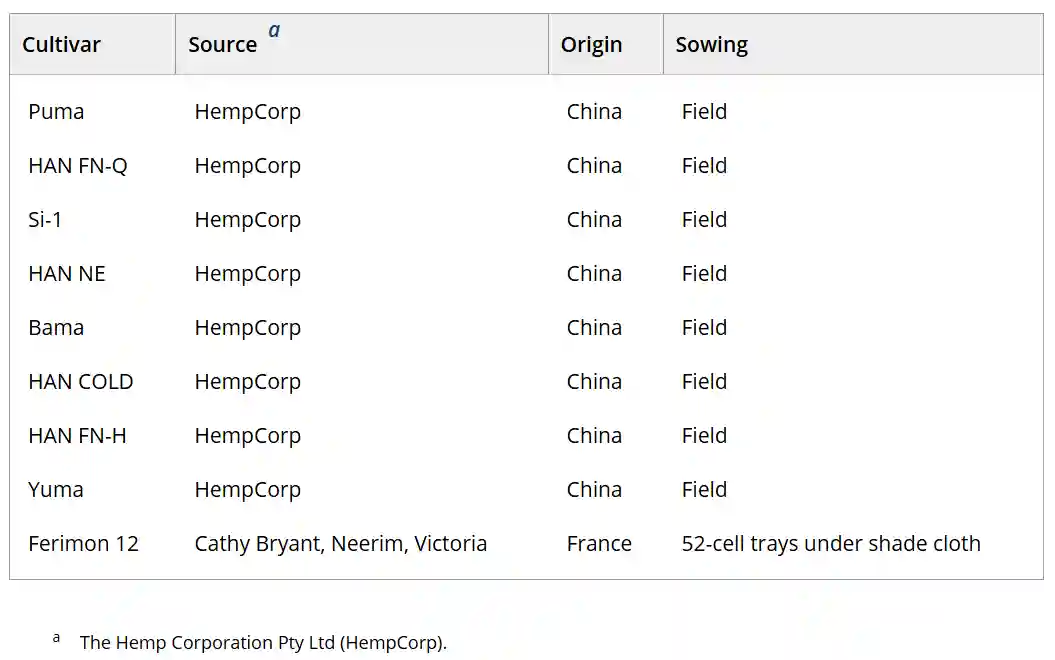 List of all dioecious hemp cultivars evaluated. Source: Matros et al., 2023
Researchers employed hyperspectral imaging to capture reflectance spectra from the leaves of nine industrial hemp cultivars grown under different soil conditions. The collected spectral data were analyzed using various machine learning algorithms, including partial least squares (PLS), multilayer perceptron (MLP), and radial basis function (RBF) networks, to classify plant sex, cultivar, and soil type.
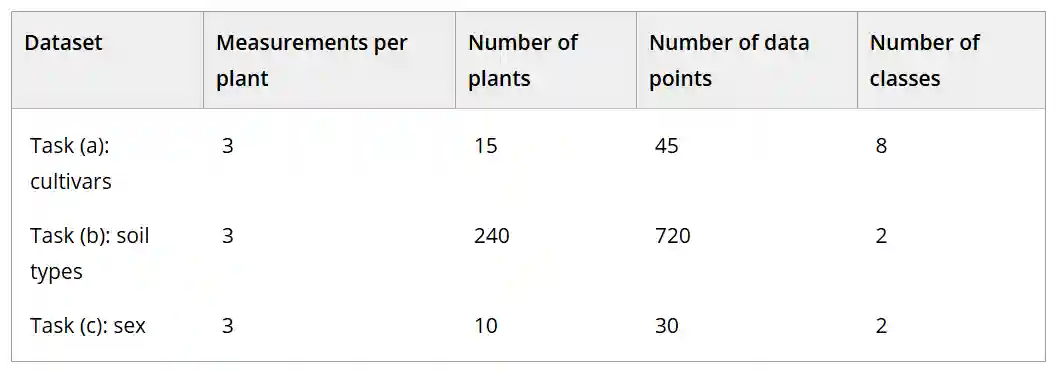 Overview of all datasets. Source: Matros et al., 2023
AI helped in this research by employing machine learning algorithms to analyze hyperspectral data, enabling accurate, non-invasive differentiation of hemp cultivars and determination of plant sex.
The study achieved high accuracy in sex classification at flowering with a correct classification rate of 100% for cultivar Ferimon 12 and overall accuracies between 60% and 87% for early growth stages.
Cultivar differentiation was also highly accurate, with a mean correct classification rate of 99.7%.
The findings suggest that hyperspectral imaging combined with machine learning can effectively distinguish between hemp cultivars and predict plant sex, enhancing regulatory compliance and productivity.
Hemp cultivators and regulatory agencies can practically apply these results to improve crop management and ensure compliance with cultivation standards.
Main Tools/Technologies:
- Hyperspectral imaging
- Partial least squares (PLS)
- Multilayer perceptron (MLP)
- Radial basis function (RBF) networks
For further details, refer to the research article by Matros, A., Menz, P., Gill, A. R., Santoscoy, A., Dawson, T., Seiffert, U., and Burton, R. A., Plant-Environment Interactions 2023.
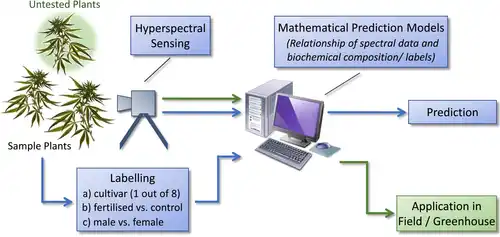 Flowchart of the mathematical modeling process. Source: Matros et al., 2023
In the figure above: The acquired hyperspectral signatures are used as input data into the mathematical model. Corresponding reference data are used as output data. According to the three tasks described above, there are three sets of labels used here forming three separate models.
Following the structure of the label information, the implemented mathematical model is an 8-class classifier for task (a) and a binary classifier for task (b) and (c), respectively. Following the general approach of machine learning, the discrepancy (calculated via a standard mathematical error function) between actual and desired output of the model (prediction value) is being minimized during the modeling process. The lower path of the workflow (blue arrows) is not required in productive operation once the mathematical model is sufficiently trained and subsequently used to process all incoming hyperspectral signatures of new (untested) plants based on the learned relationship between input and output data. These yields downstream applications in the field and greenhouse (green arrows). Source: Matros et al., 2023
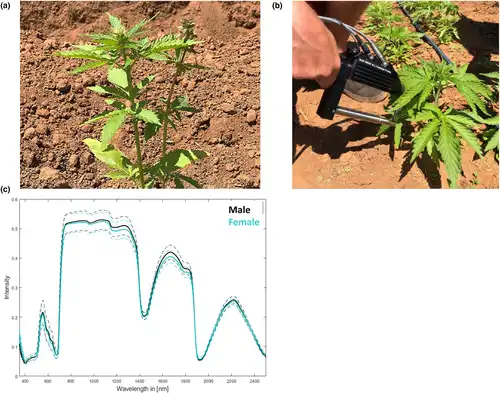 Hyperspectral measurement of flowering dioecious hemp plants from cultivar Ferimon 12. Source: Matros et al., 2023
In the figure above: (a) A female (left) and a male (right) plant of the cultivar Ferimon 12 at the time point of measurement (17/02/2020, 4 weeks after sowing and 1 week after planting into the field). (b) The actual measurement of a leaf with the field portable full range spectroradiometer. To avoid environmental illuminations, a leaf clip was combined with the plant probe. (c) The mean reflectance spectra acquired for the cultivar Ferimon 12 from three leaves per plant from five male and five female plants, resulting in 15 spectra each. Dotted lines indicate the variance range.
 Hyperspectral measurements of dioecious hemp plants before flowering. Source: Matros et al., 2023
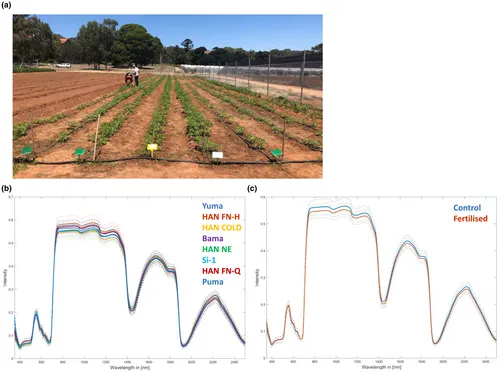
In the figure above: (a) The field setting at the measurement day (17/02/2020). Hemp cultivars from left to right are Yuma, HAN FN-H, HAN COLD, Bama, HAN NE, Si-1, HAN FN-Q, and Puma. Spectra were acquired from three leaves per plant from 15 plants per cultivar from two soil conditions (fertilized and control), resulting in 90 spectra per cultivar and 720 spectra in total. (b) The mean reflectance spectra of the eight different cultivars across both soil conditions, and (c) the mean reflectance spectra of the two soil conditions across all cultivars. Dotted lines indicate the variance range.
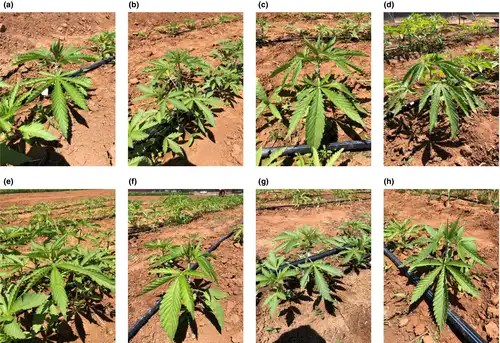 Images of all dioecious hemp cultivars evaluated at the measurement day (17/02/2020). Source: Matros et al., 2023
In the figure above:
- (a) Yuma,
- (b) HAN FN-H,
- (c) HAN COLD,
- (d) Bama,
- (e) HAN NE,
- (f) Si-1,
- (g) HAN FN-Q, and
- (h) Puma.
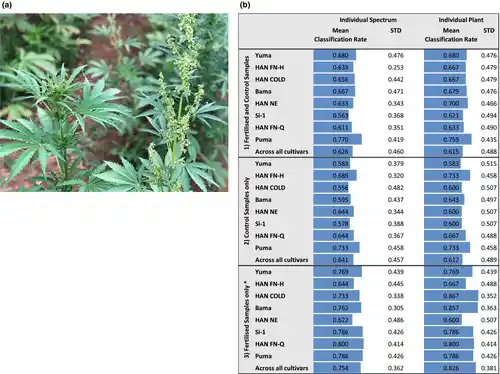 Early prediction of sex of dioecious hemp plants. Source: Matros et al., 2023
In the figure above:
- (a) A photographic image of a female (left) and a male (right) plant of the cultivar HAN FN-H at the time point of sex annotation (05/03/2020, 9 weeks after sowing into the field).
- (b) The mean accuracies for the prediction of sex from reflectance spectra measured from leaves before flowering (17/02/2020). Compared are the mean classification rates by individual measurement and by entire plant for three datasets:
- (1) containing all spectra acquired from each cultivar (fertilized and control conditions, 15 plants each with three leaves per plant measured; 90 spectra per cultivar in total),
- (2) containing all spectra acquired from each cultivar grown on control conditions (15 plants each with three leaves per plant measured; 45 spectra per cultivar in total), and
- (3) containing all spectra acquired from each cultivar grown on fertilized conditions (15 plants each with three leaves per plant measured; 45 spectra per cultivar in total). Significant improvement of classification rates for plants grown under fertilized conditions is indicated by *; paired t-test, p = .0015 (individual spectra) and p = .0044 (entire plant) when compared with dataset (1) as well as p = .0005 (individual spectra) and p = .0006 (entire plant) when compared with dataset (2).
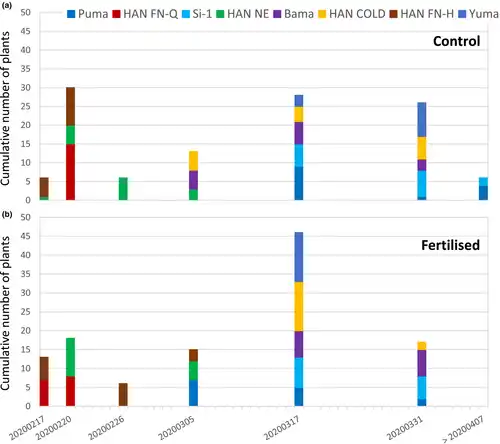 Comparison of flowering time of the eight hemp cultivars. Numbers of plants per cultivar which flowered at a certain date are represented as stacked bars. (a) shows results from plants grown under control conditions and (b) from plants grown under fertilized conditions. Source: Matros et al., 2023
🟢 What’s next in Hemp Tech?
In the next article of “AI for Hemp” series we will look at applying machine learning for understanding and modelling hemp chemotypes.
How do you like our next topic?
Share your thoughts in the comments below or in direct message to [email protected]
Thank you for your time!
Hemp Phenotyping with AI
Understanding Leaf Area Measurement for Hemp Cultivation
Leaf area measurement is a critical metric for monitoring hemp plant health and growth efficiency. By quantifying the surface area of leaves, growers can assess the plant’s photosynthetic capacity, which directly impacts energy production and overall yields.
Accurate leaf area measurements allow cultivators to detect stress, optimize light exposure, and adjust irrigation or nutrient delivery for maximum plant performance.
Tools and Techniques for Leaf Area Measurement
Modern tools, such as the Petiole Pro Android app for leaf area measurement, make it easier than ever to measure hemp leaf area accurately.
Advanced technologies such as AI-driven image recognition can process leaf size and shape quickly not onlyin small scale hemp farming but even in large-scale hemp operations.
Regular monitoring ensures plants receive optimal care, helping growers make data-driven decisions for healthier hemp crops and higher yields.
 Petiole Pro offers an Android app for Hemp Leaf Area Measurement